2016 Whisky Wind-down, 8: American Classics


Today’s dram: Bulleit Bourbon

Today’s tasting notes: Bite. Such bite. But it gets sweeter as you sip. Benefits of a high rye content. Good stuff. 

Today’s thoughts: Despite the spelling, Bulleit is pronounced “bullet” and is as American as your favorite cliché. 

I make my favorite cliché mostly for holidays. This year, with the help of my five-year-old nephew, I successfully completed the task.   

Today’s deep-dish thought: It’s only pie. Relax. 

Today’s toast: To the bakers: May your calculations be correct and your pies rise as expected. 

2016 Whisky Wind-down, 9: Travel, Tours, Tastings


Today’s dram: Woodford Reserve, Distiller’s Select

Today’s tasting notes: This is fine bourbon. The aroma is all sweetness, a touch of honey on a warm breeze. Sip it. Warm, sugary, with just a faint bite. A subtle burn fades down the throat. Smell it again. Stare into the distance. Sip. Life is good. 

Today’s thoughts: As I mentioned back in Whisky Wind-down 24, The Empress of Whisky and I embarked upon a lengthy tour of Kentucky bourbon country last year, hitting up many, many distilleries along the way. One of those was Woodford Reserve. 

It’s a lovely facility, sitting on a historic site where bourbon was made as far back as the early 1800s. Between the stone buildings, newly filled barrels are rolled along a set of metal tracks — think barrel railroad — to the warehouses where they will rest for six years or more until a master distiller decides they are ready to incorporate into the next small batch of bourbon. 

It’s a homey sort of place, the type that dedicates a bronze plaque to commemorate the life of a favorite distillery cat. The people are lovely, and every tour is partly the story of making bourbon and partly the history of bourbon and Kentucky. 

I’ve said this before, but I’ll repeat myself: If you enjoy whisky, go to where they make it. Meet the makers. Taste the rare stuff that isn’t sold elsewhere. 

The Empress of Whisky and I had a grand time in Kentucky. Likely we will go back someday, visit some of the smaller distilleries that lie even farther off the beaten path. 

First, though: Scotland. 

Today’s note on travel: There are some pretty good whiskies available in tiny bottles. You can fit at least ten into a TSA-compliant quart-size zip-top bag. 

Today’s toast: To vistas on vacation: Ahhh. 

2016 Whisky Wind-down, 10: Family Time


Today’s dram: Crown Royal

Today’s tasting notes: Remember when I described how smooth and easy I found Crown Royal Limited Edition? This is the regular stuff. It’s still pretty smooth for whisky, but it has a bit of an edge to it. Along with a fair amount of sweetness, too. 

Today’s thoughts: This was not on my draft whisky list, and I am not a huge fan of Canadian  whisky overall, but I am a huge fan of enjoying a drink with family. This is one of my father-in-law’s favorites, so when I saw him tonight and he said, “Let’s have a drink,” I could hardly refuse. (You’ll have to ask him why he drinks from a coffee mug.)

Today’s advice to anyone anxious over holidays with family: Whisky can be a common denominator. 

Today’s toast: To holiday mingling: Cheers!

2016 Whisky Wind-down, 11: The Price of Admission


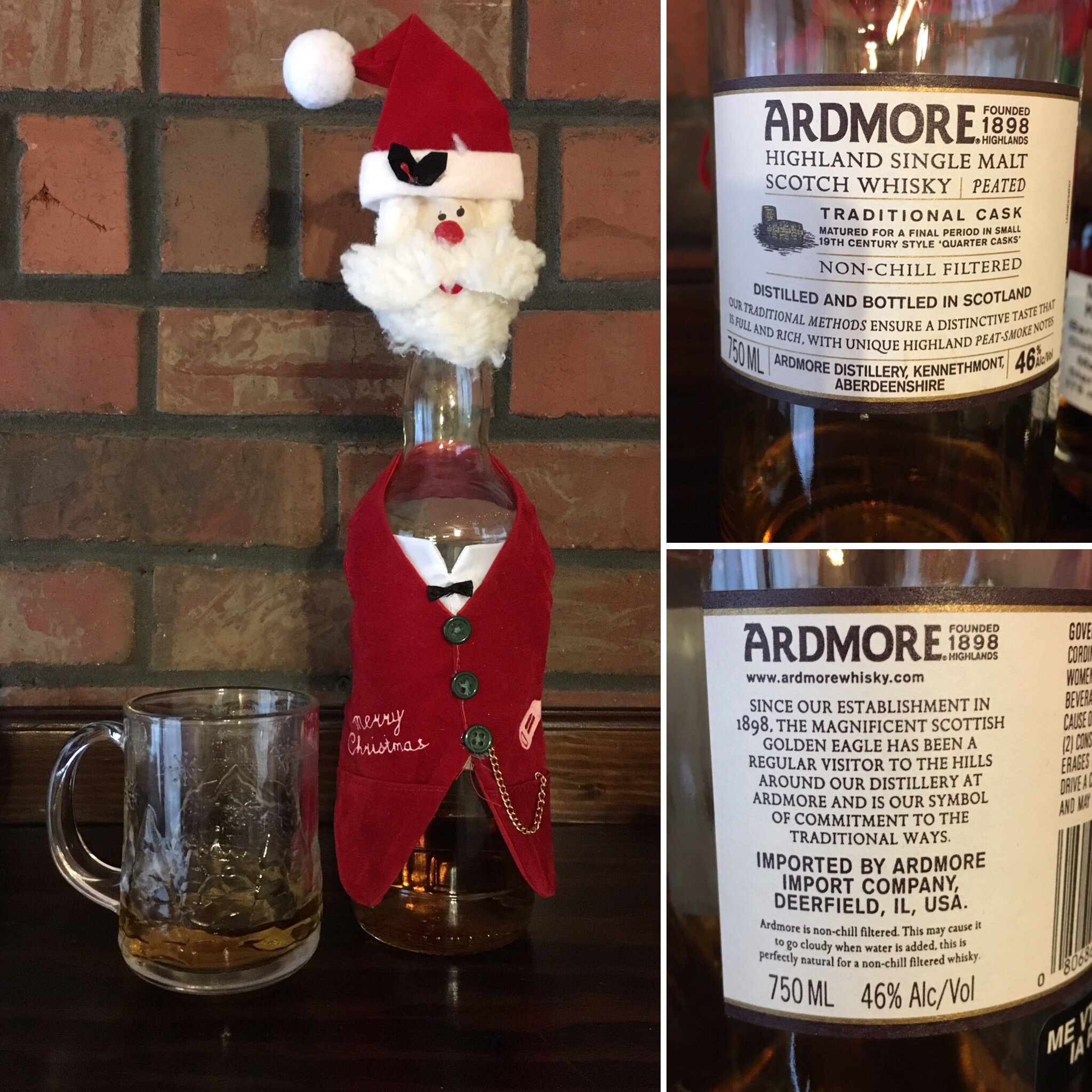
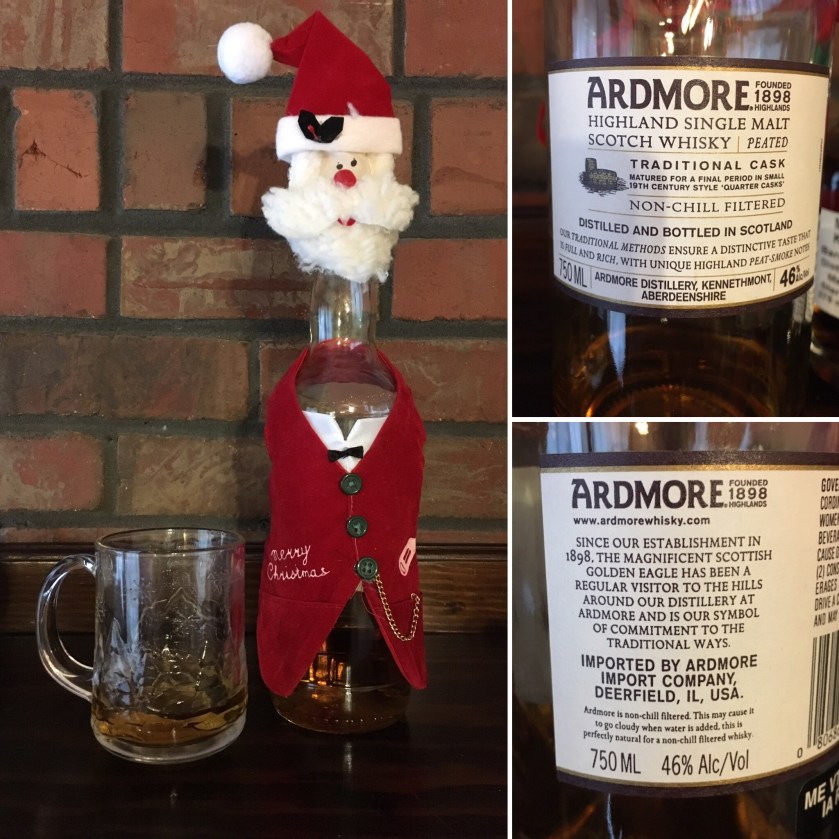
Today’s dram: Ardmore, Traditional Cask (Peated Single Malt, No Age Statement), dressed for the holidays

Today’s tasting notes: Full, rich, warm Highland single malt with a pleasant earthy aroma and plenty of peat on the way down.

I’ve had this bottle kicking around for a bit, but I just went looking for more information on it and learned a couple of things: 1) It won a gold medal in the Highland Single Malt — No Age Statement category at the 2010 World Whiskies Awards. 2) It is no longer being made, having been supplanted by a different line from Ardmore.

Since this whisky lacks an age statement, let’s talk about what that means. (For your sanity and mine, we’ll stick to Scotch whisky, since age statements mean different things to different types of whisky.)

Say you are a distiller with some whisky you have been aging for 12 years, but you aren’t happy with it as-is and feel it needs a bit of mellowing to be just right. You don’t want to wait another year (or two or three), so you decide to mix in a bit from an older batch to get the flavor profile you seek.

First, so long as you’re using another whisky made at the same distillery with the same ingredients and methods, you can still call it single malt. So long as it’s all malted barely distilled at the same location, it qualifies, even if you end up blending different batches of different ages. (The term blended Scotch whisky refers to one that is made from multiple malt whiskies made at different locations OR one that contains grain whisky in addition to malt whisky. Or both. If that sounds confusing, well, yell at the next member of the Scotch Whisky Association you meet.)

So, you think that 12-year-old whisky needs a bit of older whisky mixed in to mellow it out. Even if you add some of your precious 25-year-old to the mix, you still have to call it 12-year-old on the age statement, which legally must be no older than the youngest whisky included. (So, even if you went barking mad and produced a mix that was 99% whisky aged 25 years, with the remaining 1% aged only 12, legally you would have to sell it as a 12-year-old whisky. Right after you got your head examined, I suppose.)

So, what’s the big deal with No Age Statement whisky?

The rise of NAS whisky (as the kids call it) is allowing Scotch whisky distillers to meet today’s increased demand for good whisky by using younger (minimum aging three years) products, blended perhaps with a bit of precious older stock, to make new expressions.

Generally, such whisky is marketed as an artful creation of master tasters, rather than an expedient answer to demand in a booming market.

It’s either that or sell less whisky.

It’s not like there’s a way to speed up the aging process … wait a minute … there is, sort of.

Let’s talk about quarter casks.

These smaller vessels hold less whisky (duh) so it’s a more labor-intensive, materially-expensive way to mature whisky, and you don’t see them employed very often.

The advantage of this method — aside from being able to use nifty marketing spiel about “19th century methods” — is that the whisky spends more time in contact with the wood, owing to the greater circumference-to-volume ratio. Or something. Pi may be involved.

Point is, more contact means more flavor, faster.

Also, being able to say you used “traditional methods,” hearkening to the days when casks had to be lighter to fit on the backs of the donkeys who would carry them through the Highlands, well … it helps people get over their snootiness about your lack of an age statement.

Rounding back to the beginning, the whisky in my glass today was produced in quarter casks, and it has no age statement.

Some people have a philosophical beef with both those factors. For them, Scotch whisky that does not display an age statement, but does use marketing as cover for a distillery’s changing methods, is to be looked down upon.

Me? I can’t say I’m indifferent to these factors, but I care more that you’re serving a good whisky for the price you’re asking.

This fits the bill. It’s a full, flavorful peaty whisky that compares well to many 10- or 12-year-old Highland single malts I’ve had the pleasure of sampling.

Today’s thoughts: The distillers who laid down their whiskies a quarter-century ago might well have thought they were making enough, or more than enough, to meet the future’s demand. Long-term gambles like that are very difficult to get right.

It’s almost as difficult, say, as having children and then wondering what your life will be like a few decades hence when they bring home their spouses for the holidays.

<cough>

I like to think my in-laws are at least tolerant of their poet-in-law. I’ll ask them again in a day or so.

Today’s observation on holiday decor: If you think a whisky bottle dressed as Santa is weird, you should see my mistletoe-bedecked bourbon.

Today’s toast: To families coming together for the holidays: May your homes be as warm and inviting as a good Highland single malt, however old.

 

2016 Whisky Wind-down, 12: Procrastination 


Today’s dram: Laphroaig, 18-Year-Old

Today’s tasting notes: Strong, deep breath of the sea. Somewhere a fire is burning. Sit here and remember with me, the things we loved in days gone by.

Today’s thoughts: This one is a bit late, especially considering I had basically all day to get it done.

Well, not all day.  

I had presents to wrap, shopping to finish, dishes to catch up, probably other tasks that are slipping my mind …

So, I slept in.

I thought I might just have a quick lunch and then get going, but Cat looked at me pitifully, so I sat on the couch and let her flop with me a bit.

Then she reminded me the remake western The Magnificent Seven just dropped for streaming rental today, and she really likes westerns and The Empress of Whisky (who does not) is away hiking, so …

Yeah.

Decent flick. It ain’t Seven Samurai, but then, what is?

Then an unusual thing happened, the sort of thing that I suppose happens a lot but I never notice because I am away at work — a crew came by to pressure-wash our building. The water made weird sounds out there, and the sounds made Cat anxious, so I stayed on the couch to console her, and I decided to read a bit …

Next thing I knew, The Empress of Whisky was home with dinner.

Not only had I accomplished nothing on my personal to-do list, I also had yet to even pick today’s whisky.

The topic, however, basically writes itself.

I have long had the great ability to put off ’til tomorrow what cannot be accomplished today.

“And what can be put off ’til tomorrow might just as easily be put off ’til day after tomorrow as well.”

I forget who said that, but I remember it was Douglas Adams who said, “I love deadlines. I love the whooshing noise they make as they go by.”

I love being on holiday when the only deadline I have is a self-imposed one to daily drink a dram and then write about it.

I realize how incredibly fortunate a position that is to be in. Moreso, I realize how, when I’m not on holiday I mostly work by a set of generous white-collar deadlines that would be the envy of most workers the world over.

So being unhappy that I cannot meet my own deadlines is an admittedly advantaged position in which to find myself.

Doesn’t make it any easier. But I do acknowledge it.

Today’s deeply morbid thought on tomorrow: A good friend of mine — the same who gave me the Laphroaig 18 — once said to me, as I was lamenting my lack of progress, feeling like I was spending too much time on trivial pursuits, “Someday this will all be dust and no one will be here to remember or care; so, in the long run, idle chit-chat is about as useful as anything short of building an empire.”

Today’s toast: To the reader: I’ll have something for you tomorrow. Probably.