2016 Whisky Wind-down, 18: Other Good Uses for Grain


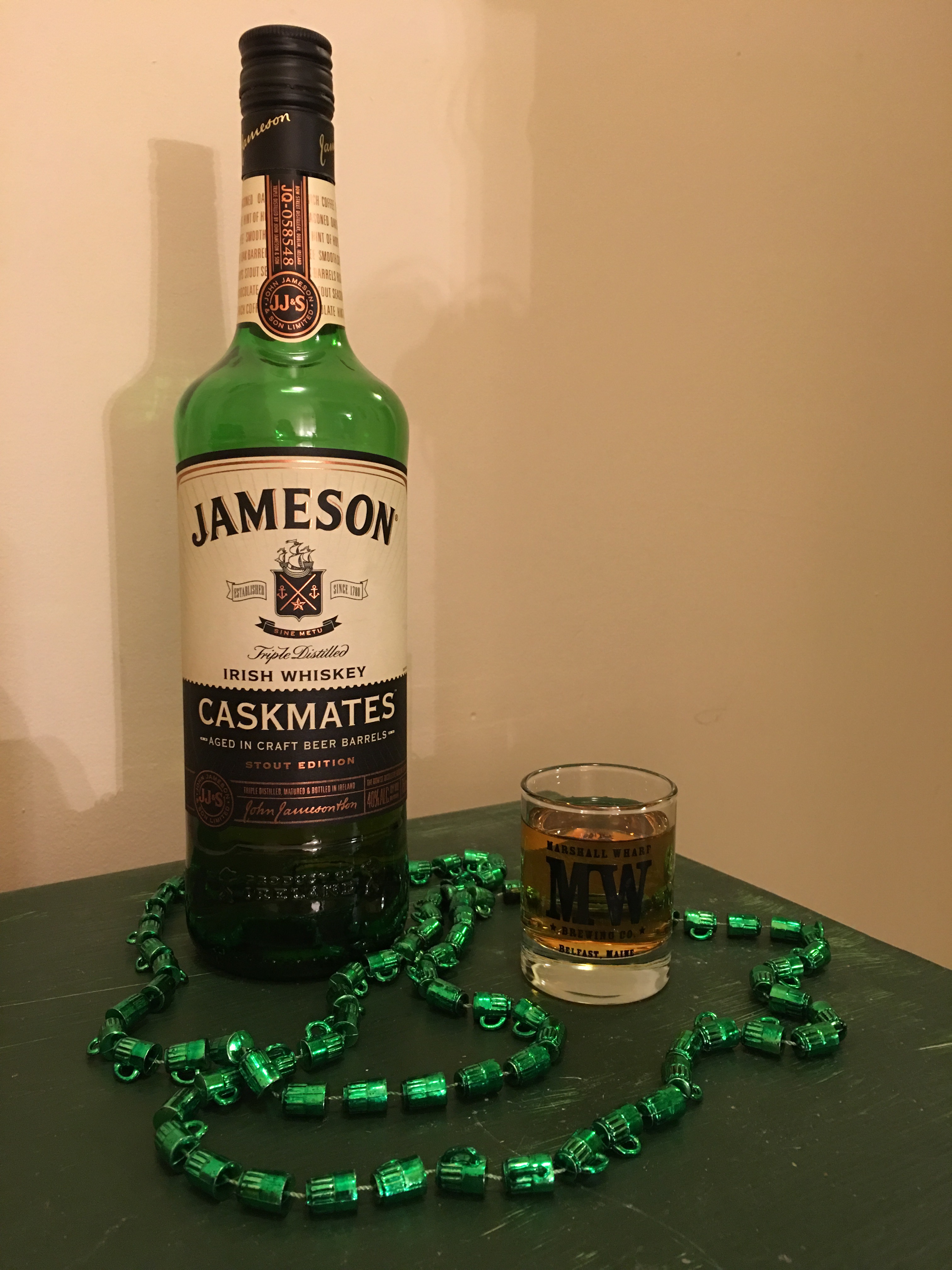
Today’s dram: Jameson Irish Whiskey, Caskmates (Stout Edition)

Today’s tasting notes: Before I tell you how it tastes, I should really make note of how it’s made.

As I mentioned back in Whisky Wind-down Interlude: Terminology, and further discussed in Whisky Wind-down 24, whisky barrels get reused a lot. Many begin life holding bourbon, then, since they can’t be reused for bourbon, they get sold off, mostly to other distilleries making other types of whisky.

Lately, however, some brewers have taken to buying used bourbon barrels and using them to age beer, particularly high-gravity stouts, barleywines, and Belgian-style ales.

Given this disruption to their supply lines, it was probably just a matter of time before some clever whisky maker decided to strike back.

Enter Jameson Caskmates.

The distillery partnered with a local brewery, Franciscan Well, to mature some of its whisky in barrels that had been used to age stout.

That sounds somewhat straightforward, but it’s actually a little more complicated.

Jameson usually matures only in barrels that formerly held bourbon and fortified wine. The distillery took a set of its used barrels to the brewery, which used them to age stout, then sent them back, were they were used to further age regular Jameson.

So it went: bourbon, fortified wine, Jameson, stout, Jameson again.

Whew!

And for all that? The distillery’s tasting notes indicate this lends the whisky flavors of cocoa, coffee, and butterscotch.

I can’t say I perceive all of that, but this is definitely a whisky that has been spending time at the brewery. It’s darker and richer than pure Jameson, and I rather enjoy it.

Today’s thoughts: So, it may surprise you to learn I don’t only drink whisky.

Sometimes, I reach for beer.

Okay, a lot of times.

Okay, maybe even more than whisky.

I rather enjoy brewery tours, and The Empress of Whisky and I make a point of looking for them wherever our travels take us.

It’s a good time to be a beer drinker. The United States has more breweries now than at any point in its history (~4,200), but almost two-thirds of those were founded in the last decade. Beer is booming, and there’s probably a local brewery near you. Check it out.

I’ll surely write more about beer later, especially if I follow through on becoming a certified beer judge. (Plans are in motion.) 

Today’s note on a future objective: Acquire Franciscan Well’s Shandon Stout and Jameson Aged Stout.

Today’s toast: To all the makers of the all the fermented beverages: Cheers!

2016 Whisky Wind-down, 19: On Distant Shores


Today’s dram: Pusser’s Rum, Original Admiralty Blend

Today’s tasting notes: This is not whisky. Cry foul if you want, but I’ll defend the inclusion here. As far as process goes, this shares much with whisky, from small batch wooden stills to aging three years minimum on charred oak. The key deviation that makes this rum, not whisky, is the mash: sugar cane.

The taste profile isn’t like your typical rum at all. It drinks more like a sweet bourbon, say a wheated version with a corn-heavy mash.

It’s sweet, but not cloying. It has rough edges, but not serious bite. I could sip this all day.

Point of fact, I have.

Honestly, though, I love this stuff as much for its history as its flavor. From the mid-1600s through July 31, 1970, the British Navy issued a daily rum ration (a “tot” of rum) to its sailors. This was all very regulated and full of pomp and tradition, down to the exact rum to be used.

This stuff? It’s made to the British Admiralty’s specifications.

For the duration of the rum ration, that recipe was not shared. The rum was never made available to the public until Pusser’s Rum Ltd. purchased the rights to make and sell the blend (and use British Navy iconography). About a decade after the rum ration went away (they called it Black Tot Day) the rum became available to the public for the first time, with a portion of proceeds benefiting the Royal Navy Sailors’ Fund.

Today’s thoughts: A friend of mine is currently serving as an officer in the U.S. Marine Corps.

It may be somewhat odd that an ancient British Navy rum recipe makes me think of an American Marine, but, well, that’s how my mind works sometimes.

Though I have not seen him since his appointment some 16 years ago, we have kept in touch, sporadically, over that time. Our lives are pretty different, but we are bound by a deep friendship started long ago.

And whisky.

Last time I saw him, we drank cognac and I wished him well on his journey. Next time, maybe we’ll have a tumbler of Pusser’s Rum. The 15-year-old, if I can lay hands on it.

Today’s thoughts on toasts and traditions: I like toasts. I don’t like starting a round of drinking without at least a polite “cheers.” Maybe it’s my Irish heritage (or the relatives who drilled that into me, anyway). Whatever, you may rely upon me at your wedding.

The tradition-minded British Navy has lots of toasts. Aside from the daily loyalty toast (“The Queen!”) and others for special occasions, there is one for each day of the week:

Monday: Our ships at sea
Tuesday: Our sailors
Wednesday: Ourselves
Thursday: A bloody war or a sickly season
Friday: A willing foe and sea room
Saturday: Our families
Sunday: Absent friends

Today’s toast: To my friend the Marine, away across the sea: Be well until we drink together again.

2016 Whisky Wind-down, 20: Peat, Politics, Pigs


Today’s dram: Springbank, 10-Year-Old

Today’s tasting notes: This is a bit of strange one. I was given this bottle in my early days of whisky collecting, before either I or my wife (aka, The Empress of Whisky, who delights in favoring her loyal subject with gifts of the water of life) knew exactly what we were doing. She bought it, if I remember correctly, mostly because it was a rarity at the bottle shoppe, the only Campbeltown whisky on offer.

Some history: Springbank is an old distillery, with its Campbeltown production facility dating to 1828. Back then, this whisky region was home to more than two dozen distilleries. Today, only three remain.

Springbank is family-owned, a rarity in these days of global booze conglomerates. It’s also one of only a couple of distilleries that does pretty much the entire whisky production process on site, from malting the  barley to distilling the spirit, from aging the whisky to bottling it. About the only thing they don’t do is grow their own barely. (There is a distillery that does so, but alas I haven’t any of that in my collection.)

So, historic, local, quirky … how does it taste?

Oily.

Or, more precisely: It tastes like fermented canola oil with a touch of peat, salted.

Which is not to say I don’t like it. But it is, shall we say, a whisky for a certain mood, one that strikes but rarely.

Today’s thoughts: So, pigs.

It’s been a long hard year, made worse by the events of November 8, when a minority (albeit an electorally well positioned minority) of Americans chose to elect as president an odious marionette of tainted meat stuffed into an ill-fitting suit.

I really do want to just have fun with Whisky Wind-down, but let’s be honest — kinda the whole reason I’m doing this in the first place is to take my mind off the shitstorm that is 2016. Letting the entire series go without at least touching on politics would be somewhat incomplete.

So, where do we go from here?

“He who fights with monsters should look to it that he himself does not become a monster. And if you gaze long into an abyss, the abyss also gazes into you.”

That’s Nietzsche, of course.

“I learned long ago, never to wrestle with a pig. You get dirty, and besides, the pig likes it.”

George Bernard Shaw this time, saying perhaps the same thing?

I wonder. There are days when it feels like all the effort in the world doesn’t amount to more than pig-wrestling, and at the end I just sit there, dirty, while the bastards grunt back at me, wondering why in the fuck I ever bothered.

But other days, when I squint right, I don’t see the sty. I see the bleak pit of the abyss, its gaping maw clamoring to consume the world’s last beauty. 

And that’s worth fighting for. 

Today’s pithy summation: There will be a time to make bacon.

Today’s toast: To the good fight: May we be ready for it. 

2016 Whisky Wind-down, 21: Tatanka! 


Today’s dram: Buffalo Trace, Single Barrel

Today’s tasting notes: So, this was acquired a bit by accident. We were running low on bourbon, but I didn’t feel like the longer drive to the excellent bottle shoppe where I normally shop. Instead I visited a local package store. It’s a pretty good store on its own, but it has a lesser selection. I wasn’t looking for anything special, though, just an inexpensive everyday bourbon. Buffalo Trace was about the best bet of what was on offer, but they were out of standard 750 ml bottles. They did, however, have one 1.75 liter bottle available. Though it was more than I intended to buy, the price was good, and hey, it’s not like my wife and I won’t eventually get through this.

It was only when I got home that I noticed the small gold sticker on the side that says “Tower Spirits Single Barrel Select.” Weird. Especially since the shop I went to wasn’t Tower Spirits, and they did not charge me a premium single barrel price. Huh.

So I looked up the Buffalo Trace single barrel program and learned — as I suspected, having some familiarity with this concept — that Buffalo Trace allows high-volume buyers the option to buy all of a single barrel and have it bottled exclusively for that store.

How this bottle ended up at my local independent shop I have no idea. 

I also had no idea how this bourbon would vary from regular old Buffalo Trace. Note that it isn’t cask strength; this is the usual dilution, just all from one barrel, not the typical blend of 20-30 that make the standard Buffalo Trace. (That’s considered small batch, I think.)

This could be subtle or stunning, depending on any number of factors in production. And what characteristics was the Tower Spirits buyer into? Is this stronger, smoother, sweeter, milder, wilder, what?

I didn’t want to just try this blind, but fortunately we happened to have a smidge left in our last bottle of regular Buffalo Trace. (This was what prompted the shopping trip, after all.)

And so, my wife and I set up a side-by-side tasting.

The results?

The color is a shade darker, but the aroma is identical (or close enough for our senses, anyway). 

On taste, we agree the select version has a bit more of an edge to it and is slightly less sweet than the regular. These are subtle differences, though, between essentially two versions of the same product. This select barrel would have been paired with other, sweeter, milder barrels to make a batch of the regular. 

All in all, good stuff. I plan to pick up a bottle of the regular to have on hand for future comparisons. We can share this fun with whisky-loving guests. 

Today’s thoughts: My wife has a Buffalo Trace shirt that says “Party Animal.” Pictured upon it is a large buffalo, standing stoically on a bluff.

That’s basically me, at parties.

Also, I will drink your whisky.

Today’s bourbon trivia: Buffalo Trace is a fun distillery. The wife and I visited during our whirlwind Kentucky bourbon vacation last year. Located adjacent to the Kentucky River in Frankfort, it’s like a little village that makes bourbon. The distillery has been around since the late 1700s and has had several names and owners over the years, but it has almost never stopped making bourbon. (Even during Prohibition, when the bourbon made there was sold for <cough><cough> medicinal use only.)

Today, the distillery makes several brands besides the namesake, and their production method is common to distilleries that have multiple lines. Some distilleries have a complex system of barrel rotation that, combined with careful blending, results in a consistent house style for a particular bourbon line. (Maker’s Mark takes this to an extreme by not even making more than the one base bourbon.*) Buffalo Trace doesn’t do that. They have several mash bills, and they send certain barrels of certain ones to certain levels of the racks and they leave them there, for however many years they deem necessary. Four years later, the same base bourbon, made with the same mash bill, is two different bourbons when one was aged at the ground floor and the other in the attic. Bottle one and call it George T. Stagg. Bottle the other and call it Eagle Rare.** Science!

Also, and I mean this seriously, a rickhouse is what heaven must smell like.

I say that partly in jest, but it’s grounded in bourbon lore. As the whisky ages in these buildings, which are not climate-controlled, the natural cycles of heat and cold move the liquid in and out of the wood, drawing the oak flavor and the natural wood sugars released in the charring, making raw whisky into bourbon.*** One reason Kentucky is such good bourbon-making country is the variance of the weather throughout the year, accelerating this process. In the midst of that, some is lost to evaporation, and that is why the air smells so wonderful. Bourbon makers call this loss the “angel’s share” because it rises away. The longer the aging, the more the loss. Which, aside from the time involved, is a factor in the cost of older aged bourbons — there’s just less of it.  On a related note, Scotch whisky does not suffer as much loss, what with the more stable year-round temperatures there versus Kentucky. That stable temperature is also why the youngest Scotch whisky for sale is usually at least 10 years old, with 12 far more common and the good stuff taking 15, 18 or more. Time works slowly in Scotland.

Today’s toast: To party animals everywhere: Be excellent to each other. (And party on, dudes.)

—–

* — If you read Whisky Wind-down 24, you know 46 is just an alteration of the base style. (Basically, they follow one process through to completion, creating the namesake bourbon, but sometimes they then experiment from there. So far, they’ve only marketed and sold one of those experiments. I don’t count cask strength versions separately, since those are still made with the same process, just undiluted at the end. (You could turn a cask strength whisky into its standard version, though you would have to be an animal — not a party animal, just a terrible person — to do so.)

** — These are examples only, not exact, though those are both brands made there. Four years, by the way, is the minimum for Kentucky straight bourbon to be sold without an age statement. (If it’s younger, you’re supposed to say so.) Good bourbon commonly ages a bit longer, at least six or seven years. (If memory serves, that’s the standard for brands like Buffalo Trace and Maker’s Mark. But people we talked to everyone say time is never exact. Master tasters begin sampling, then keep checking up until it’s deemed ready. Merciful squid, what a job.)

*** — Several of the the folks we talked to on our tours repeated variations of the phrase, “We don’t make bourbon. We make white dog. Nature makes bourbon.” (White dog is what bourbon makers call the raw whisky that comes off the still. Were they doing this illegally, it would be called moonshine. Side-note: Ever had moonshine? Or white dog? Talk about harsh! Imagine straight-up vodka. From a not-so great vodka maker. Add some acid. That’s about it. It’s amazing what time on charred wood turns that stuff into.)

2016 Whisky Wind-down, 22: Go With the Flow


Today’s dram: Resurgens, single malt rye

Today’s tasting notes: Bread. A warm loaf of bread. At least that’s how it smells. And this is a whisky I could enjoy on smell alone. But smell is not intoxicating, so … the taste is spicy, as you might expect from rye. It has bite, but it probably won’t bowl you over. Probably. 

Today’s thoughts: This is not the whisky I planned to review tonight, but I let myself go. To a party. With people. People who brought booze. For the party. This was on the table. 

Today’s deep philosophical musing: The Earth goes round the sun. The apes sit on the Earth. Some of the apes discover fermentation. Good apes. Goooood. 

Today’s toast: To relaxation — it’s good for the soul.